Circa 1780 Netherlands


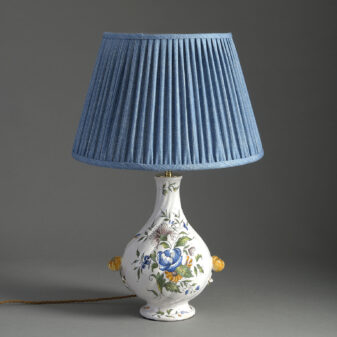
Late 18th Century Blue & White Glazed Delft Vase Lamp
£2,650
1 in stock
Height 16 inches (40.5 cm)
Width 6 1/2 inches (16.5 cm)
Depth 6 1/2 inches (16.5 cm)
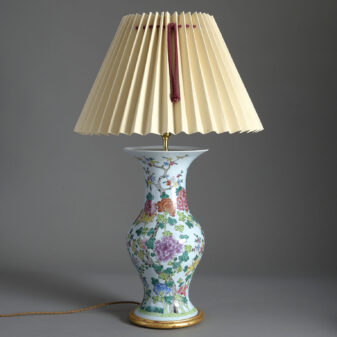
A late eighteenth century Delft pottery garlic neck vase, decorated throughout with stylised flowers and foliage. Now mounted upon a giltwood base as a table lamp.
Dimensions exclude modern bulb fitting.
Wired to UK Standards. This lamp can be rewired to all international specifications.
Shades available to purchase separately.
Blue and white Delft vases are emblematic examples of Dutch tin-glazed earthenware produced initially in Delft, The Netherlands, from the early seventeenth century until the mid-nineteenth century. Delftware arose from European potters’ efforts to imitate Chinese blue and white porcelain imported in large quantities by the Dutch East India Company. As native Dutch clays lacked the kaolin required to produce true hard-paste porcelain, Delft artisans adapted tin-glazing techniques originating from Italy to create an opaque white surface with luminous cobalt decorations. This process resulted in earthenware that visually referenced Asian imports while remaining materially distinct.
Delft pottery became a major export commodity in Europe, and vases were among the most common objects produced alongside tiles, dishes, and ornamental wares. When the supply of imported porcelain was temporarily disrupted, Delft factories expanded production to satisfy European demand for blue and white ceramics, often adopting Chinese motifs alongside more traditional European scenes and patterns.
Blue and white Delft vases are exemplary of late eighteenth century European decorative arts. Delft vases are valued not only as historical artefacts but also as adaptable design elements, for example, repurposed as lamp bases, making them a valuable item for both collectors and interior designers.


Other Suggestions